In this guide
Before looking for a “free Fintwist ATM,” decide what you need: physical cash, a balance check, or money in a separate bank account. Those are different activities. Corpay Prepaid provides an ATM locator, but a locator result should be read alongside your own card agreement and the terms displayed for the transaction. Provider: ATM locator
This guide compares cash-access questions rather than claiming that every machine, store or card program has the same terms. It does not use your location, find a live nearby machine, or verify whether a particular ATM is operating. The locator is an external provider tool; the comparison below is editorial analysis.
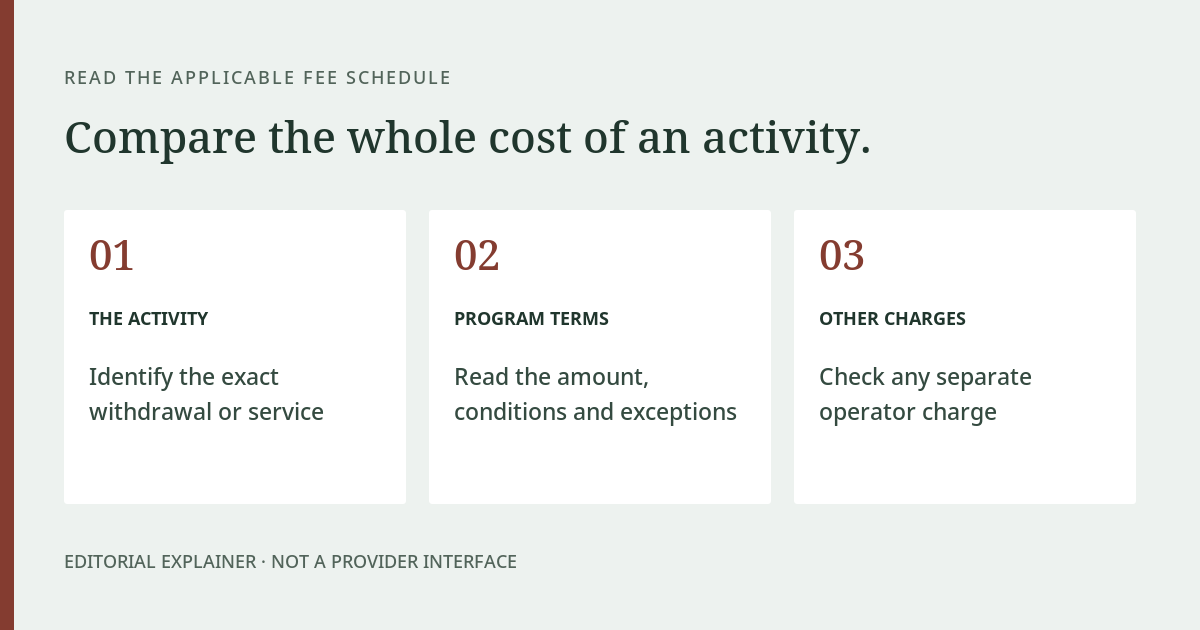
Start with the destination, not the machine
A cash withdrawal is useful when the destination is your hand. It is not the same result as sending funds to a bank account. A balance inquiry supplies information rather than money. Keeping these outcomes separate avoids paying for an action that does not solve the original problem.
For example, imagine that a reader needs to make a payment from an existing checking account. Withdrawing cash still leaves the question of how and when that cash can be deposited into the account. Another reader may need to pay a cash-only vendor, in which case an electronic transfer does not finish the task. These are hypothetical use cases, not recommendations for any particular account.
Write the intended outcome in a short sentence before comparing routes. “I need cash for this purchase” is more precise than “I need to cash out.” That precision helps you ask about the relevant amount, timing, access conditions and charges rather than collecting a list of unrelated features.
Compare routes with the same questions
| Route | Questions to establish first | Separate issue to remember |
|---|---|---|
| ATM withdrawal | Is this machine in the applicable network, and what terms appear? | A balance inquiry is a different action |
| Cash back with a purchase, where supported | Does this retailer and card program allow it, and under what conditions? | You are also authorizing a purchase |
| Teller withdrawal, where supported | Does this bank participate, and what identification and terms apply? | A branch location does not prove participation |
| Transfer to your own bank, where eligible | What destination details, fees and timing apply? | This produces a bank credit, not physical cash |
The table deliberately asks questions instead of filling unknown boxes with assumed benefits. Its purpose is a fair comparison. Before relying on a route, confirm that your card program supports it and that the place you plan to use can complete it.
Use the locator as a location tool
Open the provider’s current locator from its own website and search for the area you actually need. Then inspect the particular result rather than assuming that every machine operated inside the same retail chain belongs to the same network. Record the location privately when planning a trip; this publication does not need your precise address.
A result is one piece of information. If the machine presents a charge or a term you did not expect, pause and compare it with the applicable agreement before accepting. Do not treat a result from an old article or a screenshot taken by another person as a current transaction quote.
There is also a distinction between finding a listed location and verifying live operation. This article does not know whether a machine has cash, is temporarily unavailable or can dispense your requested amount. Avoid making a time-sensitive plan depend entirely on an unverified assumption about a single machine.
Do not bundle an inquiry into a withdrawal
The CFPB explains that prepaid-balance checks may be available through several channels and that some methods, including an ATM inquiry, may carry a fee. The card agreement is the place to check the charge for the method you use. CFPB: balance-check methods
That makes an inquiry worth considering separately, even when you intend to withdraw money at the same machine. A sign about withdrawals does not answer a different question about checking a balance. Read the activity you are authorizing, not just the screen’s overall branding.
The broader lesson is that two consecutive actions can have different terms. Keep separate lines for them in the fee worksheet. This is more useful than describing the entire visit as a single “ATM transaction” and then being unable to identify which action produced an unexpected charge.
Cash back is a purchase-plus-cash question
Where your program and retailer support cash back, ask about both parts of the transaction. What purchase are you making, what amount of cash is requested, and what conditions apply? Do not turn a general mention of cash back into a claim that every store must provide it or that a purchase is unnecessary.
If a cashier or terminal describes a limit, establish whether it is the store’s rule, the account’s rule or a transaction-specific restriction. Those are different questions and may require different sources. This guide does not publish one universal limit because the sources reviewed do not establish one for all programs and merchants.
Keep the receipt and compare the resulting account entry with what you authorized. A question about the combined amount is not necessarily the same as a question about a separate fee. Describing the receipt precisely helps the provider understand which part you are asking it to explain.
What to record when cash is not dispensed as expected
If an account entry and a cash transaction do not agree, write down the time, location, requested amount and what the machine actually did. Preserve any receipt privately. Do not repeat transactions merely to see whether the problem disappears while losing track of which attempt produced which entry.
Use the card provider’s error-reporting process promptly when you believe an account entry is wrong. Corpay Prepaid publishes an electronic-transfer error-resolution route; the applicable agreement and authorized support process remain important for your specific account. Provider: error resolution
A useful report describes observations rather than a theory: “The machine returned this message, no cash was dispensed, and this entry is visible.” That wording gives the provider something concrete to investigate. The transaction guide explains how to distinguish documenting an observation from determining the eventual outcome.
A decision that matches the original task
The comparison is complete only when the route solves the destination problem at terms you understand. A nearby machine is not automatically the best route to a bank-account payment; a transfer is not automatically suitable for an immediate cash need. No single label such as “free” can settle those differences.
For an electronic destination, continue to bank-transfer eligibility and records. For costs, keep the applicable schedule beside the route comparison. This approach does not promise a particular outcome, but it helps ensure that the action you authorize is the action you meant to take.