In this guide
There is no responsible way to turn a search for “Fintwist fees” into one universal price list without first identifying the card program. Start with the fee schedule supplied for your account and any later change notices. The CFPB explains that prepaid-card fee disclosures distinguish charges and the circumstances in which they apply; a general claim that a card has low costs is not a complete schedule. CFPB: understanding prepaid disclosures
This guide helps you read that schedule as a set of activities. It does not assign fees to your account or calculate an official quote. Its purpose is to turn “Will this cost me?” into a precise question about the action, the program, and any other party involved.
A real example of why scope matters
The provider’s EmployBridge page contains a named PR 05 fee table. It separately identifies an out-of-network withdrawal charge and an ATM balance-inquiry charge, while listing several other activities as free. Elsewhere on the same page, older advice favors credit over PIN transactions even though the displayed table and upgrade notice describe zero point-of-sale fees for that program. Provider: EmployBridge program resources
That is a document conflict worth noticing, not a reason to publish the page’s numbers as everyone’s current terms. Our conclusion is narrower: a specific fee table and a broad instructional paragraph can diverge even on one official page. Ask which schedule currently applies to your account and retain the answer. Do not silently resolve the conflict by choosing the instruction that promises the lowest cost.
WATCH & UNDERSTAND · 36 SECONDS
Read the fee line, not just the amount
Original visual explainer · silent · no autoplay
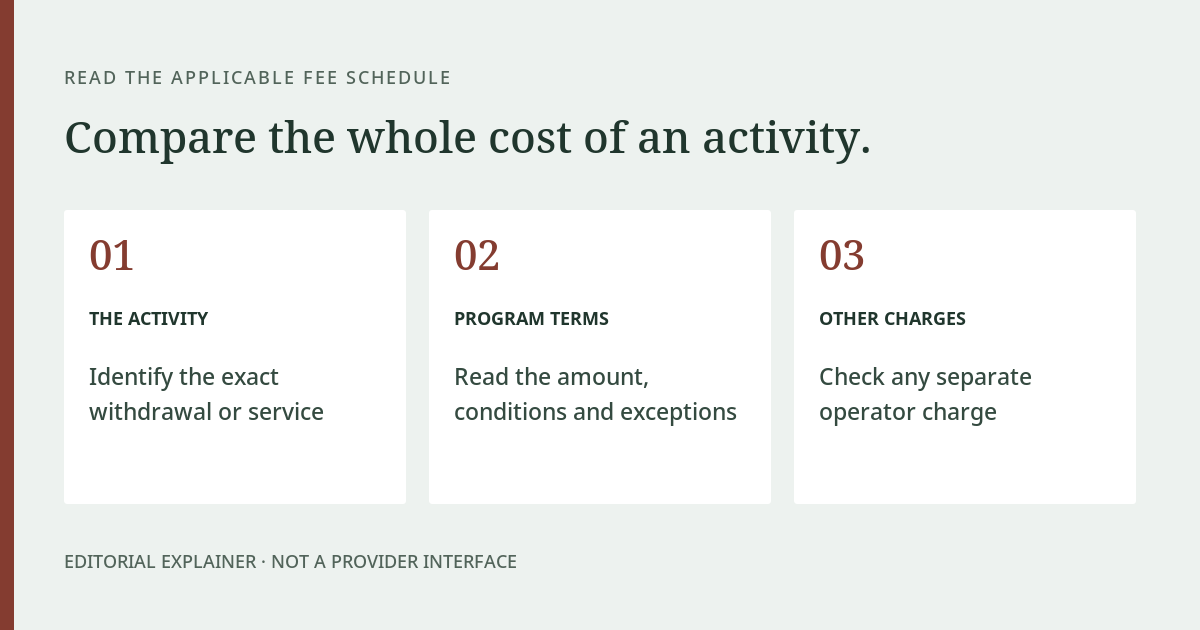
A four-step reading framework: identify the applicable program, the activity, its conditions and the party charging it. No invented fee rates are used. This is an editorial illustration, not a provider tutorial or a recording of an account. Video files are served by this website.
Read the full video explanation
- Identify the current fee schedule that applies to your card program. Read each fee together with the activity and the condition, not as an isolated number.
- Withdrawing cash from an ATM and checking a balance at an ATM are different activities. A statement about the cost of one does not establish the cost of the other.
- Check the applicable network, method and other conditions on the relevant fee line. Do not borrow an unrelated employer program’s rates.
- Distinguish the card program’s charges from any separate charges that actually apply to the transaction. This reading framework includes no fee quotation or invented rate.
Source context: CFPB: prepaid fee disclosures. The visual arrangement and hypothetical examples are editorial explanations.
Read a fee as an activity plus a condition
An amount without its label is incomplete information. “ATM” might mean a withdrawal, an inquiry or an activity on a particular network. “Replacement” may mean the card itself, while a different term addresses delivery. A monthly charge may have a condition that depends on account activity. Read the label and the condition together.
Build a personal list of the activities you actually expect to use. Someone who mainly makes purchases has a different cost question from someone who needs cash after every payday. A feature you never use may not affect your usual costs, although occasional charges and account-closure conditions still deserve attention.
| Activity to check | Question for your schedule | What not to assume |
|---|---|---|
| Taking out cash | Which network and withdrawal rules apply? | Every machine at a familiar retailer has identical terms |
| Checking a balance | Is this particular channel charged? | A free withdrawal implies a free inquiry |
| Moving funds to a bank | Is the transfer type available and priced separately? | Every action described as a transfer has the same fee |
| Replacing a card | What applies to replacement and delivery? | A free card implies free expedited shipping |
| Leaving funds unused | Is there an inactivity definition and charge? | Not using the physical card means the account has no activity |
Separate provider charges from other costs
A useful comparison records who would impose each cost. Do not combine a card-program fee, an ATM operator’s on-screen surcharge, a retailer’s condition or a separate bank’s charge into one vaguely described “Fintwist fee.” These may concern different parties and different steps.
The practical check is at the point where you can still decide whether to proceed. Read the transaction’s displayed terms, compare them with your account schedule and pause when the two seem inconsistent. A familiar location or a free-use claim in an old article is not enough to resolve a new on-screen charge.
A balance check also deserves its own line. The CFPB notes that methods of checking a prepaid balance can have different charges and that the agreement should explain them. This is a reason to compare channels, not a statement that every card offers the same free option. CFPB: checking a prepaid balance
A small cost worksheet, without invented rates
Use the formula number of charged activities × applicable charge, then add any other charges that actually apply. Leave a line blank until you have the rate for your program. A blank is more honest than importing a number from another employer’s table.
For a hypothetical illustration, four activities charged at $2 each would total $8; two activities charged at $2 would total $4. These are arithmetic examples, not Fintwist rates or a recommendation to change withdrawal behavior. The example shows why frequency belongs in a comparison alongside the amount of each charge.
Also record the outcome you need. Reducing the number of transactions is not automatically better when it creates a different problem, such as holding more physical cash than you intended or leaving insufficient funds for another payment. A cost worksheet should make a choice understandable, not dictate a personal financial strategy.
What to ask when a fee appears unexpectedly
Identify the posted transaction and the activity you performed. Was it a withdrawal, a failed attempt, a balance inquiry or a separate service? Preserve the receipt and a private record of the screen, with sensitive data protected. Then ask the provider which fee-schedule provision explains the charge.
A useful question is: “Which activity was charged, which schedule applies, and where is that term shown in my current agreement?” It avoids assuming the provider made an error while still requesting a specific explanation. When the amount or transaction itself is wrong, use the provider’s formal error process rather than treating an editorial email as a dispute submission.
The transaction-status guide helps distinguish a posted charge from another kind of account entry. The cash-access guide compares the questions to ask before choosing a cash route. Keeping those tasks separate prevents one article from becoming an unreliable universal troubleshooting manual.
Recheck when the underlying arrangement changes
A new employer program, replacement agreement or change notice is a sensible reason to revisit your worksheet. A new marketing name alone does not tell you that a fee changed. Match a claimed change to the applicable notice and its effective date.
The finished worksheet should have an identifiable program, a source date, a defined activity and a confirmed term for each number. That is a useful reference you can update. A copied online table with no account applicability is not, even when the table originally came from an official source.