In this guide
- First, separate the card from the paycheck
- A paycheck is not an account balance
- Identify the program before following instructions
- Choose a reading route that fits your problem
- Accessing an account is not activating a card
- Compare ways of using money, not just feature names
- Read the evidence in the right order
- Keep account support and publication contact separate
- A better starting point than a universal answer
Fintwist is the name many employees still associate with a payroll card, while the provider’s current consumer website uses Corpay Prepaid. That makes a simple search unexpectedly complicated: you might be trying to understand a card, find the correct account service, identify a charge, or ask why a paycheck has not arrived. Those are different tasks, and they do not all belong with the same organization. Provider: current consumer website
Start with the card and the question, rather than with a search result that promises to solve everything. This guide explains the basic arrangement and helps you choose the right reading path. It is an editorial guide, not a place to sign in, activate a card, move money, or submit an account dispute. Keep card numbers, identity documents and passwords out of messages to this publication.
First, separate the card from the paycheck
A payroll card is an account arrangement an employer uses to deliver wages. The Consumer Financial Protection Bureau describes it as a prepaid card arranged by an employer, with pay loaded to that account rather than sent to an employee’s separate bank account or issued as a check. That definition describes the payment method; it does not tell you which employer calculated the wages, which company maintains the card website, or which bank issued a particular card. CFPB: what a payroll card is
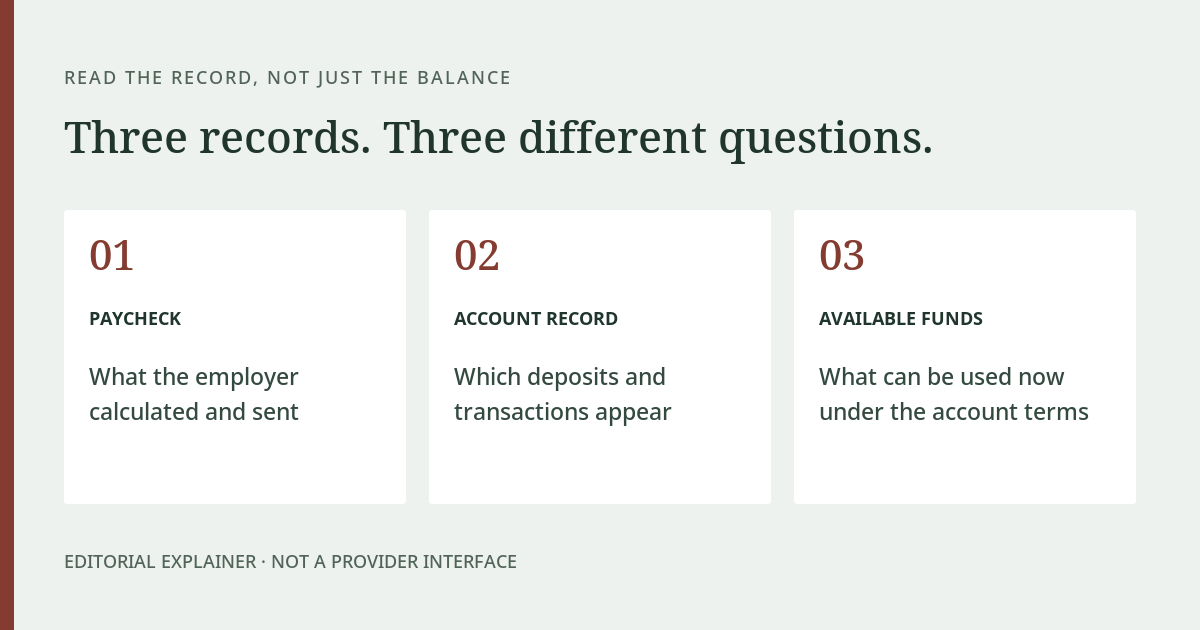
A useful way to think about the arrangement is to keep three questions separate. What was I owed? is a payroll-record question. What reached my account? is a transaction-history question. What can I spend or transfer now? is an available-funds and account-function question. A screenshot answering one of them is not automatically evidence about the other two.
For example, imagine a pay statement showing net wages of $640 while the account shows a balance of $510. Neither number alone proves an underpayment. You would first look for the deposit itself and then for subsequent account activity. Conversely, a correct-looking pay statement does not establish that the intended account received the payment. This is a hypothetical diagnostic example, not a report about an actual cardholder or a promised account balance.
WATCH & UNDERSTAND · 36 SECONDS
A paycheck is not an account balance
Original visual explainer · silent · no autoplay
A hypothetical example separates the wage statement, the deposit entry and later account activity. It does not calculate or inspect a reader’s balance. This is an editorial illustration, not a provider tutorial or a recording of an account. Video files are served by this website.
Read the full video explanation
- A wage statement, a deposit entry and account activity answer different questions: what was owed, what arrived, and what changed.
- In this hypothetical example, a statement shows $640 in net wages. That statement is a payroll record, not proof that the card account received the payment.
- Locate the actual deposit entry and compare it with the statement. The example deposit is also $640. Establish that both records concern the same payment.
- If the example account then has $130 of spending and no other activity or holds, $510 remains. This arithmetic illustration is not an account calculation, a report of underpayment, or a guarantee about available funds.
Source context: CFPB: payroll cards. The visual arrangement and hypothetical examples are editorial explanations.
Identify the program before following instructions
The current provider homepage distinguishes PayCard, intended for payroll, from FlexCard, intended for program-dependent payments such as incentives and reimbursements. It also tells readers to consult the back of the card for the issuing bank. Those distinctions matter more than whether an old bookmark contains the word Fintwist. Provider: card types and issuer disclosure
Write down a non-sensitive identification note for your own use: the program name, the issuing bank’s name, the date of the agreement, and the employer or organization that supplied the card. You do not need to circulate a photograph of both sides of the card to establish those facts. When contacting an authorized service, follow its secure verification process rather than posting that note publicly with account identifiers attached.
Do not use another employee’s fee table as your own agreement. Even a document hosted by the provider may be written for a named employer program. Its usefulness depends on who it covers and whether it has been superseded. The more specific an instruction is—an activation code format, a particular telephone number, a transaction fee—the more important it is to match that instruction to your own program.
Choose a reading route that fits your problem
| Your question | Start with | What that guide helps establish |
|---|---|---|
| Why do I see a different company name? | The name-change guide | Which public changes are documented, and what they do not prove about your account |
| Which instructions apply to my card? | Issuer and feature differences | How to match product claims to a bank and program |
| What will using the card cost? | Reading the fee schedule | How to compare a specific activity with the right fee category |
| I need to move money to my bank | Understanding bank transfers | How to separate eligibility, submission and receipt |
| My wages seem to be missing | Tracing a missing paycheck | What to ask payroll and what to ask card support |
| I cannot get into the account | Account access and the app | How to distinguish an access problem from a transaction problem |
Use this table as a routing aid rather than a decision about what has happened to your money. None of these articles can inspect a private account. Their contribution is to help you gather the right evidence and avoid asking an organization to solve something outside its role.
Accessing an account is not activating a card
It is easy to group every first-use problem under “login,” but that label can hide the actual obstacle. Account registration, signing into an existing online profile, activating a physical card, completing identity verification and setting up an employer payment are different actions. Successful completion of one is not proof that the others have happened.
Before trying another password, describe the screen in ordinary language. Is it asking you to create a profile, verify a contact method, activate a card, or sign into an existing profile? Does the error appear before the account opens or only after you request a particular feature? This simple distinction can make a support conversation much more precise without exposing any credentials.
For account servicing, follow the route from the provider’s own consumer website or the instructions supplied with your card. Do not type card credentials into an editorial website, an unsolicited message, or a page that merely resembles a familiar login. Our account-access guide explains how to keep that boundary clear while recording useful troubleshooting information.
Compare ways of using money, not just feature names
The provider lists purchases, ATM access and bank transfers among ways to use funds, with bank-transfer access subject to its identification process. These are not interchangeable ways to solve every payment problem. Cash in your hand, a payment to a merchant, and money arriving in a separate bank account meet different needs. Provider: access options and verification condition
Suppose your actual task is to pay a bill from an existing checking account. A nearby cash machine does not, by itself, solve the final step of getting usable funds into that account. Alternatively, a bank transfer may be the wrong route when your immediate task is a cash-only purchase. Define the destination first, then compare the applicable conditions and costs.
The same discipline applies to “free.” Ask which action is free, under which program, and whether another party can charge for a different part of the transaction. A withdrawal and a balance inquiry are separate activities. A replacement card and expedited delivery are also different questions. Our cash-access article and fee guide use these distinctions without assigning an unsupported universal price to the card.
Read the evidence in the right order
For an account-specific question, begin with the current agreement and notices that actually apply to the account. Use the provider’s current support material to interpret them, and ask the provider to reconcile a conflict rather than silently choosing whichever webpage is more favorable. A general marketing article can explain an intended benefit, but it is a weak basis for promising a particular transfer time or a fee waiver.
There is a practical reason to retain dates. A current browser page may contain an older paragraph, while a printed agreement may have been changed by a later notice. “I found it online today” is a record of when you accessed the page, not proof of when the instruction was written or which accounts it governs. Save the page title, URL and the wording you are asking about in your private notes.
This publication’s source-check date means the linked public sources were consulted for the article. It does not mean that a provider employee approved the writing, that a professional reviewed your circumstances, or that the article has been tested using a live card. Where a source cannot support an exact instruction, the guide identifies the question to verify instead of inventing an answer.
Keep account support and publication contact separate
An editorial correction belongs with the publication. A missing deposit, transaction error, lost card or identity-verification problem belongs with the relevant provider or employer. Corpay Prepaid’s public contact page describes cardholder support and an in-app contact route; use your own card instructions to confirm the appropriate service for your program. Provider: contact routes
A useful support note says what you observed, when you observed it, and what outcome you need. For example: “My payroll statement lists a payment for this date, but I cannot find a matching credit in the transaction history.” That is more actionable than “the app is broken,” and it does not prejudge whether the problem began with payroll, the payment destination, or the account display.
When the issue concerns an unfamiliar transaction, do not wait for an article to establish fraud. Use the provider’s reporting process promptly. Our transaction-status guide explains the difference between documenting a concern, asking a merchant about a purchase, and formally reporting an account error. It cannot make a claim or determine a refund for you.
A better starting point than a universal answer
The most useful first step is not always another app installation or a new account. It is identifying your program, naming your actual task and choosing evidence that answers it. That approach remains useful even when branding, website navigation or an employer’s instructions change.
Keep this guide as an index, not a replacement for the account agreement. For a decision about receiving future wages, read paycard versus direct deposit. For an existing problem, choose the narrower guide above. A question framed around the correct record and the correct organization is much easier to resolve than a broad search for everything associated with a brand name.